

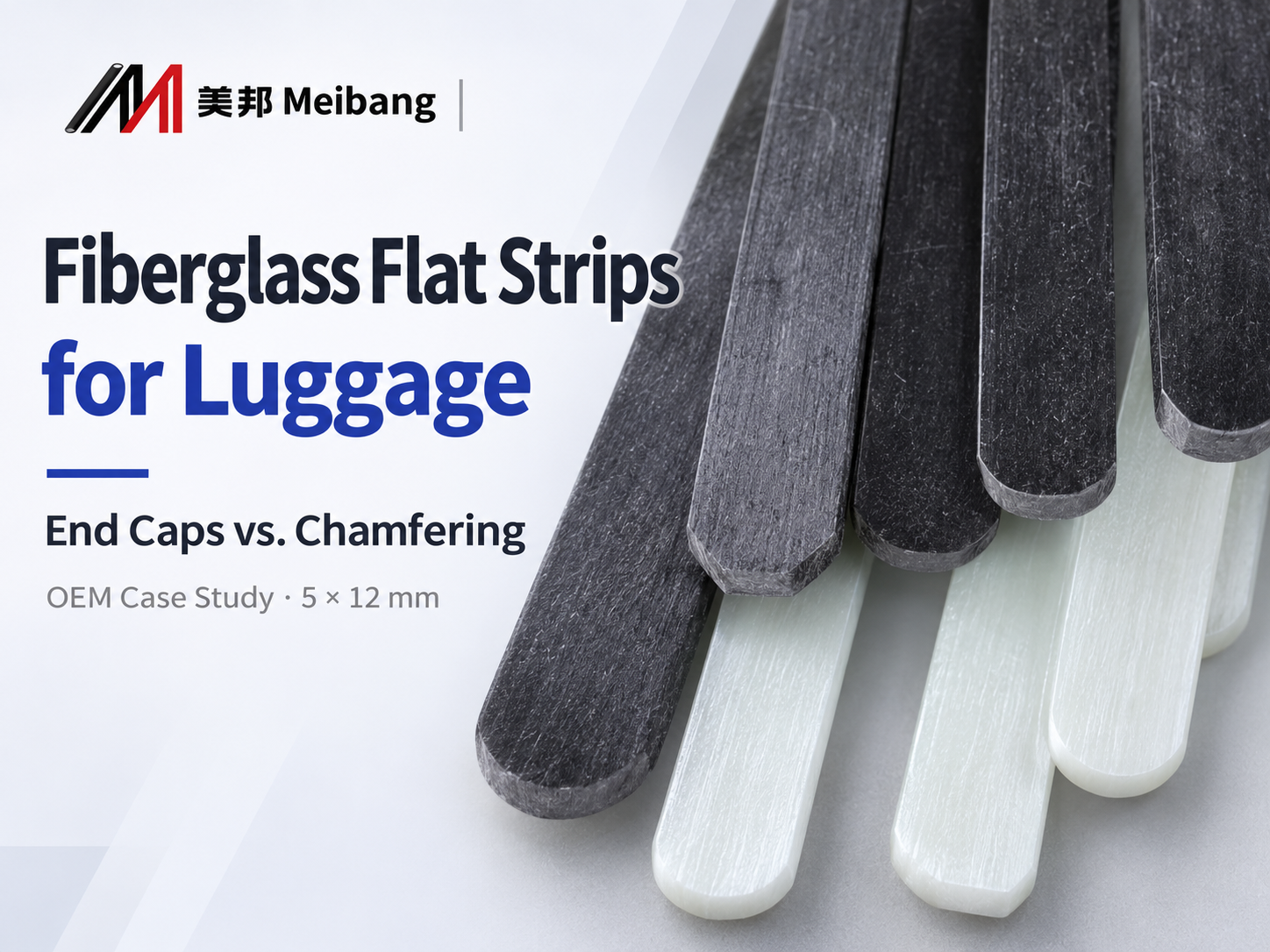
Fiberglass Flat Strips for Luggage: Can Chamfered Ends Replace Protective Caps?
A small change in end finishing can sometimes simplify a luggage component and reduce unnecessary costs.
We recently received an inquiry from a customer in Zhejiang, China, looking for 5 × 12 mm fiberglass flat strips for luggage reinforcement. The customer wanted protective caps on both ends to prevent the strips from damaging the fabric lining.
It was a reasonable request. Cut fiberglass strips can have sharp corners or exposed fibers, which may cause problems when they come into contact with fabric.
Instead of simply quoting the strips with end caps, we suggested another option: chamfering the ends and checking whether additional finishing could provide the required protection.
1. Why Consider Chamfered Ends?
Protective end caps help cover cut fiberglass ends, but they also add components and assembly work.
Chamfering removes sharp corners and may offer a simpler solution for certain luggage designs. However, the cut surfaces must still be checked for roughness and exposed glass fibers.
Here's how the two options compare:
Neither approach is suitable for every design.
If the ends press against the fabric or require cushioning, protective caps may still be the better choice. Chamfered ends are worth considering when the finished surfaces can meet the application's requirements.
2. What Happened With This Customer?
We shared reference photos of the proposed chamfered-end treatment with the customer, and they responded positively.
The idea was simple: if the ends could be finished safely without separate caps, the customer might save on additional materials and assembly work.
However, there's one important step before making that change.
The finished strip should be checked in the actual luggage assembly.
We would recommend looking at three things:
- Whether the ends have rough edges or exposed fibers
- Whether the strip contacts or moves against the lining
- Whether the finished part meets the customer's fabric-protection requirements
Testing a sample with the actual fabric would help determine whether the alternative is suitable.
The customer was interested in the suggestion, but the final solution would still need to be confirmed through sampling and evaluation.
3. Why the Lowest Strip Price Isn't Always the Best Price
For OEM buyers, the cost of a fiberglass strip isn't just the cost of the material.
Cutting, end finishing, protective caps and assembly can all affect the final price.
Removing caps may reduce material and fitting costs, but chamfering and additional finishing also require processing.
The actual savings depend on the design, finish and order quantity.
That's why we prefer to understand how a fiberglass strip will be used before recommending an end treatment.
Sometimes a small change to the part can make production simpler without changing its main function.
4. What Should Buyers Confirm Before Ordering?
If you're sourcing fiberglass flat strips for luggage or bag reinforcement, it helps to provide:
- Dimensions: Cross-section and finished length
- End treatment: Caps, chamfering or other finishing requirements
- Application: Where and how the strip will be installed
- Quantity: Sample requirements and expected order volume
A drawing, existing sample or installation photo can help us understand the project.
At Meibang, we manufacture fiberglass flat strips and custom composite profiles. We also review secondary processing requirements, including cutting and chamfering, based on the customer's application.
Our aim is to supply a part that works for the finished product, not just one that matches the dimensions on a drawing.
Frequently Asked Questions
Can chamfered ends replace protective caps on fiberglass strips?
In some applications, yes. The cut ends must be properly finished, and the customer should confirm that they meet the fabric-protection requirements. Chamfering alone does not eliminate every risk of abrasion or exposed fibers.
Is chamfering cheaper than using end caps?
It can be, but not always. The total cost depends on the finishing process, cap materials, assembly work and order quantity.
Can Meibang supply custom fiberglass flat strips?
Yes. We manufacture fiberglass flat strips and can review custom dimensions, cutting and suitable end-finishing requirements based on your drawings or samples.
Looking for Custom Fiberglass Flat Strips for Luggage?
If you're sourcing fiberglass strips for luggage reinforcement, send us your dimensions, quantity and application details.
We can help you compare protective end caps and chamfered-end options to find a suitable solution for your project.
Factory: Building A, Guanghui High-Tech Industrial Park, No. 18 Longjiang Road, Xiekeng, Qingxi Town, Dongguan, Guangdong, China
Navigation
Send Us A Message
Get in touch with us
Phone