
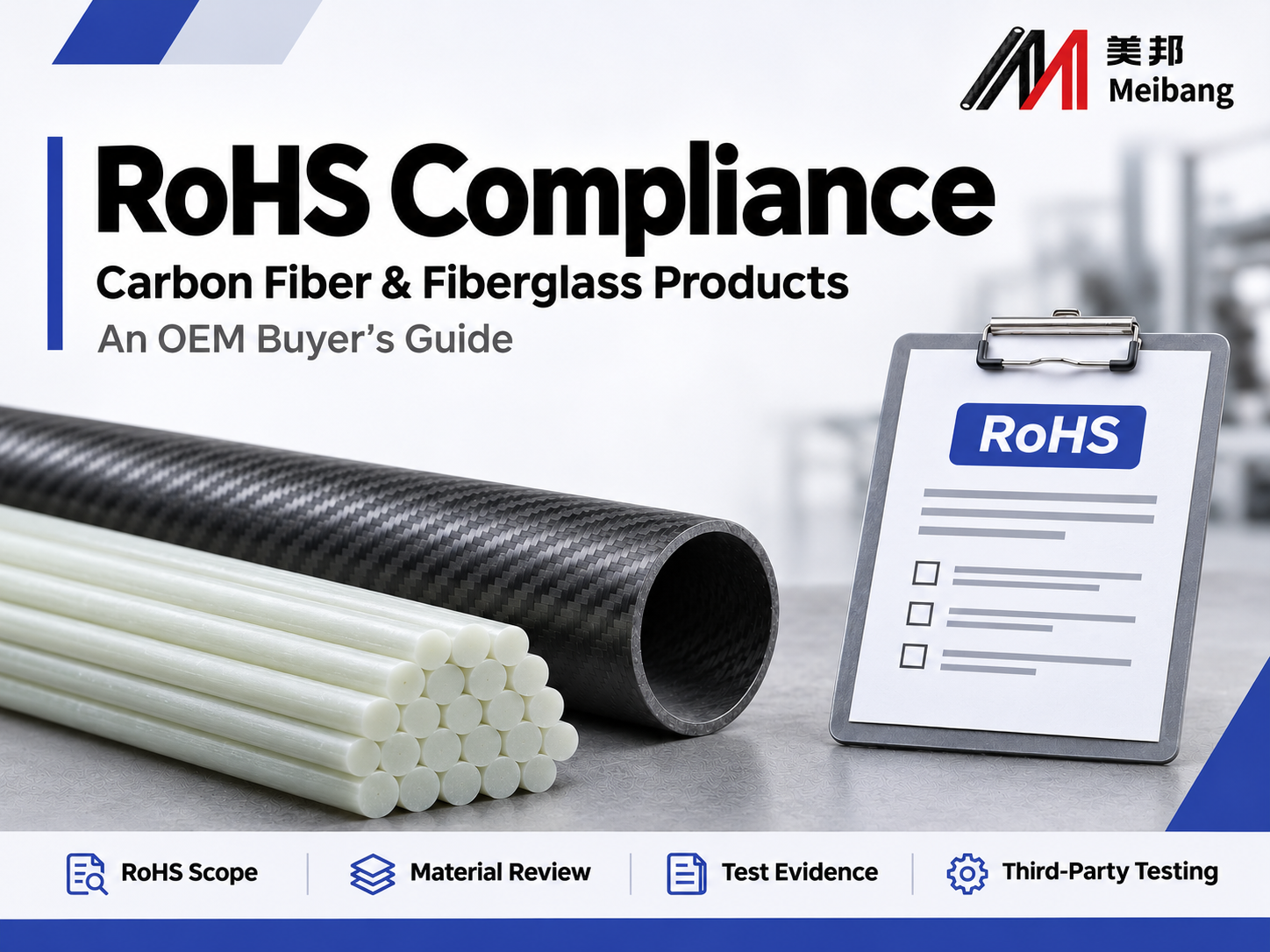
RoHS Compliance for Carbon Fiber and Fiberglass Products: What OEM Buyers Should Know
When sourcing carbon fiber tubes or fiberglass components, most OEM buyers focus on dimensions, material properties and price.
But for projects involving electrical or electronic equipment, another question often comes up before an order is approved:
Can you provide RoHS documentation for this product?
At Meibang, we have an existing RoHS test report for a carbon fiber tube sample. We also understand that custom parts may require additional testing.
Here's what buyers should know before placing an order.
1. What Is RoHS, and Does It Apply to Composite Parts?
RoHS stands for Restriction of Hazardous Substances.
EU RoHS Directive 2011/65/EU restricts certain hazardous substances in electrical and electronic equipment (EEE). Amendment (EU) 2015/863 expanded the list to ten restricted substances or substance groups:
- Lead (Pb)
- Cadmium (Cd)
- Mercury (Hg)
- Hexavalent chromium (Cr(VI))
- Polybrominated biphenyls (PBBs)
- Polybrominated diphenyl ethers (PBDEs)
- Four phthalates: DEHP, BBP, DBP and DIBP
The restrictions generally apply to homogeneous materials in covered equipment, subject to applicable exemptions.
Not every carbon fiber tube or fiberglass rod is automatically subject to RoHS. A fiberglass rod used in sports equipment, for example, may fall outside its scope.
However, when a composite component becomes part of regulated electrical or electronic equipment, the buyer may need supporting material compliance documentation.
The intended application is therefore the first thing to clarify.
2. Why Material Formulation Matters
Carbon fiber and fiberglass products contain more than reinforcing fibers.
Resins, pigments, additives and coatings may differ depending on the product.
For example, a standard black carbon fiber tube and a custom colored tube may use different surface finishes or material formulations.
This matters because a RoHS test report only provides evidence for the sample tested.
Before relying on an existing report, buyers should check whether the tested material and finish represent the product they intend to order.
If the formulation has changed, the available documentation may need further review.
3. A Real RoHS Test Report From Meibang
In 2025, Meibang submitted a carbon fiber tube sample for testing by Waltek Testing Group HCT (Shenzhen) Co., Ltd.
The sample was identified as a black carbon fiber tube with transparent varnish.
The testing covered the ten RoHS restricted substances or substance groups, with reference to EU Directive 2011/65/EU and amendment (EU) 2015/863.
The laboratory issued a report with a PASS conclusion.
The reported results were marked ND (Not Detected), meaning the tested substances were not detected at the applicable method detection limits.
Important: This result applies to the specific tested sample. It does not automatically cover every carbon fiber tube, fiberglass product or custom finish we manufacture.
For OEM buyers, the important point is whether the available test evidence matches the part being purchased.
4. Need Additional RoHS Testing? We Can Help
Some customers need documentation for a particular material, coating or finished component. In those cases, an existing report may not be sufficient.
If your custom product requires additional RoHS testing, Meibang can cooperate with the process.
We can work with customers through the following steps:
Step 1. Confirm the Requirements
Review the product application, material specifications, target market and requested test scope.
Step 2. Check the Existing Documentation
Determine whether available test reports are relevant to the proposed product configuration.
Step 3. Prepare and Submit Samples
If new testing is needed, we can help prepare representative samples and coordinate submission to an appropriate third-party laboratory. We can also discuss arrangements involving a customer's preferred laboratory.
Step 4. Review the Results
Once testing is complete, the laboratory's findings can be reviewed against the agreed requirements before the project proceeds.
Sample quantities, testing costs and lead times should be confirmed in advance.
If a result identifies a compliance concern, the affected material or product specification will need further review before proceeding.
We cannot guarantee a test result before the laboratory completes its assessment, but we can help customers organize the necessary testing arrangements.
5. What Should Buyers Check Before Ordering?
If RoHS documentation is required for your project, there are a few practical questions worth asking.
- Product match: Does the report identify the same material, formulation and surface finish?
- Test scope: Are the required restricted substances covered?
- Test results: Are the reported results within the applicable limits?
- Material changes: Has the resin, pigment or coating changed since testing?
- Additional evidence: Does the project require further testing or other supporting documents?
For finished electrical and electronic equipment covered by RoHS, component test reports can support the compliance assessment. They do not replace the applicable conformity assessment and documentation obligations for the finished equipment.
It's better to clarify these details at the quotation stage than discover a documentation gap after production.
Frequently Asked Questions
Are all carbon fiber tubes RoHS compliant?
Not automatically. The compliance requirements and supporting evidence depend on the product's intended use, materials and configuration. One test report cannot be assumed to cover every variation.
Does RoHS apply to fiberglass rods?
It depends on the application. Fiberglass rods used in regulated electrical or electronic equipment may require supporting compliance evidence, while products used in other applications may fall outside the directive's scope.
Is a RoHS test report the same as factory certification?
No. A laboratory report records results for the sample tested. It does not certify an entire factory or automatically establish compliance for all products.
Can Meibang arrange RoHS testing for custom parts?
We can assist with sample preparation and coordinate third-party testing based on the customer's requirements. The testing scope, laboratory arrangements, costs and lead times should be agreed before submission.
Does Meibang have an existing RoHS test report?
Yes. Our HCT report, issued on August 2, 2025, records a PASS conclusion for a black carbon fiber tube sample with transparent varnish. Other product configurations need to be reviewed separately.
Need RoHS Documentation for Your OEM Project?
Sourcing custom carbon fiber tubes, fiberglass rods or other composite components?
If your customer requires RoHS documentation, send us the product specifications and testing requirements. A drawing or reference photo is enough to start the discussion.
We can review whether our existing documentation is relevant or help coordinate additional third-party testing for your custom parts.
Email: meibangfrp@163.com
Factory: Building A, Guanghui High-Tech Industrial Park, No. 18 Longjiang Road, Xiekeng, Qingxi Town, Dongguan, Guangdong, China
Navigation
Send Us A Message
Get in touch with us
Phone