
NEWS CENTER
What Affects Carbon Fiber Tube Performance?
Two tubes with the same dimensions can perform differently because their materials and laminate structures are different.
3K, 6K and 12K describe carbon fiber tow sizes, while T300 refers to a carbon fiber grade. They are different specifications and should not be used interchangeably.
Fiber orientation also matters:
- 0° fibers mainly support axial and bending loads
- ±45° fibers help with shear and torsional loads
- 90° fibers help with hoop and radial loads
For roll-wrapped tubes, the laminate structure can be adjusted according to the loading requirements of the part.
What Should Be Included in an RFQ?
For a custom carbon fiber tube, we normally recommend providing:
- OD and ID, or OD and wall thickness
- Length and required tolerance
- Material or performance requirements
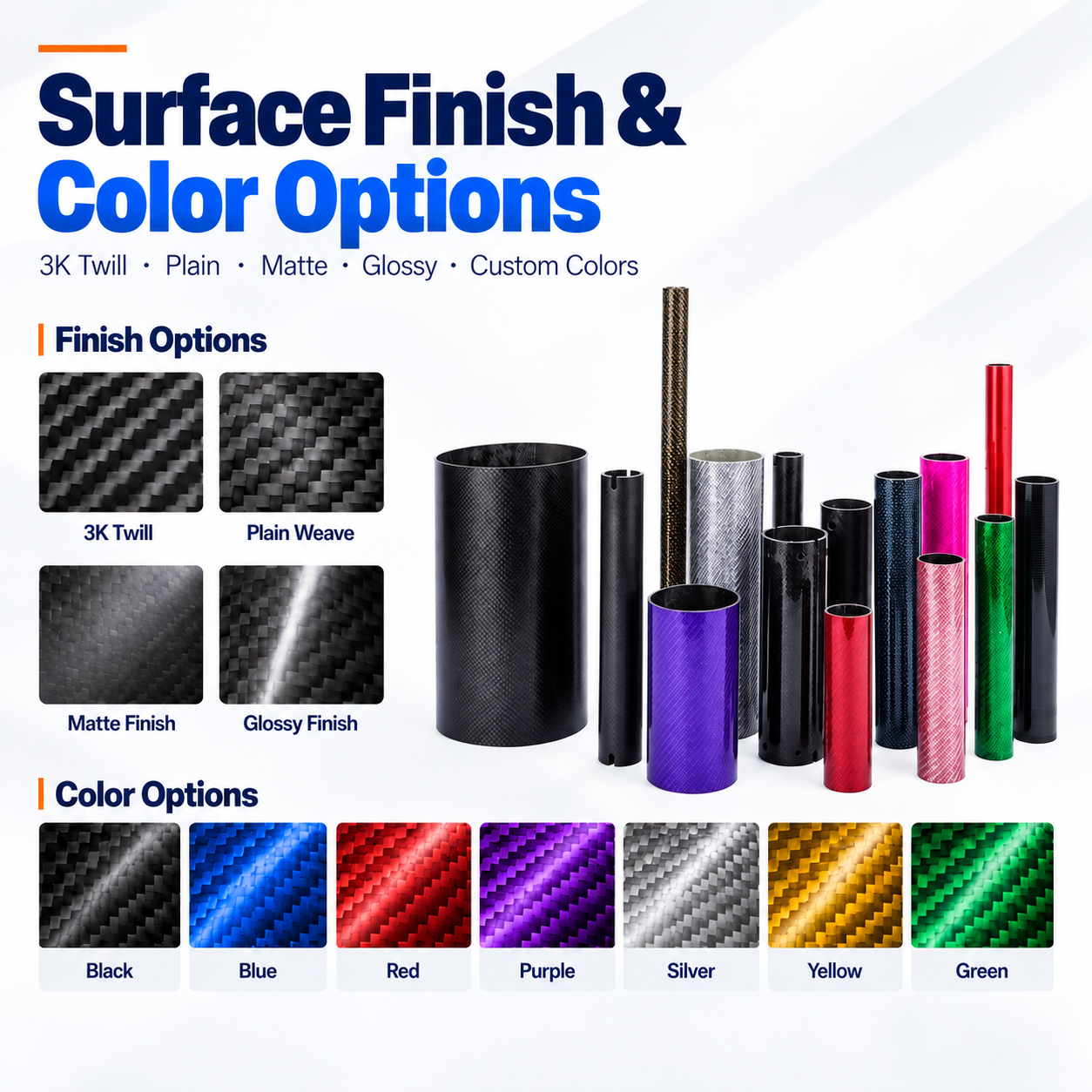
- Surface appearance — plain or twill
- Surface finish — matte or glossy
- Machining requirements — holes, slots, cutting, chamfers, etc.
- Application and connection method
For suitable Meibang projects, tube diameters from approximately 2 mm to 200 mm and lengths up to 3.5 m can be evaluated.
If the tube will fit into a clamp, metal insert or another tube, mark the critical fitting dimensions clearly on the drawing.
Which Manufacturing Process Should You Choose?
Roll wrapping is commonly used for customized carbon fiber tubes where laminate structure, fiber orientation, wall thickness and appearance need greater flexibility.
Pultrusion is suitable for continuous tubes and profiles with a constant cross-section. The main reinforcement is predominantly oriented along the length, making the process effective where longitudinal stiffness and strength are important.
Other composite processes may be considered for suitable part geometries, but the manufacturing method should be selected according to the drawing, load requirements, quantity and cost target.
CNC Machining for Carbon Fiber Tubes
Many OEM tubes require secondary machining before final assembly.
For suitable projects, Meibang supports:
- Precision cutting
- Drilling
- Slotting
- Milling
- Chamfering
- Other drawing-based machining
Threaded features can also be evaluated where the laminate thickness and joint design permit.
For higher-load connections, a metal insert may be more reliable than cutting threads directly into the composite.
What Tolerance Can Be Achieved?
For suitable tube sizes and structures, dimensional tolerances around ±0.1 mm can be evaluated.
This is not a fixed tolerance for every tube.
The achievable tolerance depends on diameter, wall thickness, laminate structure, tooling, manufacturing process and secondary machining.
The important point is to identify which dimension actually affects assembly.
For example:
- A tube installed in an external clamp may need closer OD control
- A tube fitted over an internal insert may depend more heavily on ID
- A telescoping assembly requires coordinated OD, ID and sliding clearance
Tighter tolerances should therefore be specified only where they are functionally required.
MOQ and Lead Time
For regular 3K/T300 carbon fiber tubes with common plain or twill surfaces and matte or glossy finishes, order quantities can be relatively flexible depending on the specification.
If the requested dimensions require new tooling, the project normally needs a tooling review. For a simple new-tooling project, production can typically be evaluated from 5 pieces.
Typical sample lead time is around 3–5 days after specifications are confirmed.
Typical batch production is around 7–15 days, depending on quantity, material, tooling and machining requirements.
Final MOQ and lead time are confirmed for each project.
Quality Checks
For custom carbon fiber tubes, inspection should focus on the dimensions and features that affect assembly and function.
Depending on the drawing, checks may include:
- OD and ID
- Length
- Straightness
- Surface condition
- Machined features
Critical dimensions should be clearly marked before production so they can be checked against the approved specification.
FAQ
What tolerance can Meibang achieve?
Around ±0.1 mm can be evaluated for suitable tube sizes and structures. Tighter requirements should be reviewed according to the drawing and manufacturing process.
Can Meibang machine carbon fiber tubes?
Yes. Cutting, drilling, slotting, milling and chamfering can be evaluated according to the drawing.
Can I order a prototype first?
Yes. Prototype and small-batch production can be supported for suitable projects.
How long does sampling take?
Typical sample lead time is around 3–5 days after the specification is confirmed.
Request a Quote
For quotation, send us your drawing together with the required OD and ID or wall thickness, length, tolerance, material, surface appearance, finish, quantity, machining requirements and application.
Meibang will review the dimensions, tooling and manufacturability before confirming the production approach.
Request a Quote for Your Custom Carbon Fiber Tube
Navigation
Send Us A Message
Get in touch with us
Phone