
How to Choose a Carbon Fiber Rod for OEM and Industrial Applications
A carbon fiber rod should be selected according to the finished part, not diameter alone.
For most OEM projects, five points matter most:
Load, dimensions, tolerance, connection design and working environment.
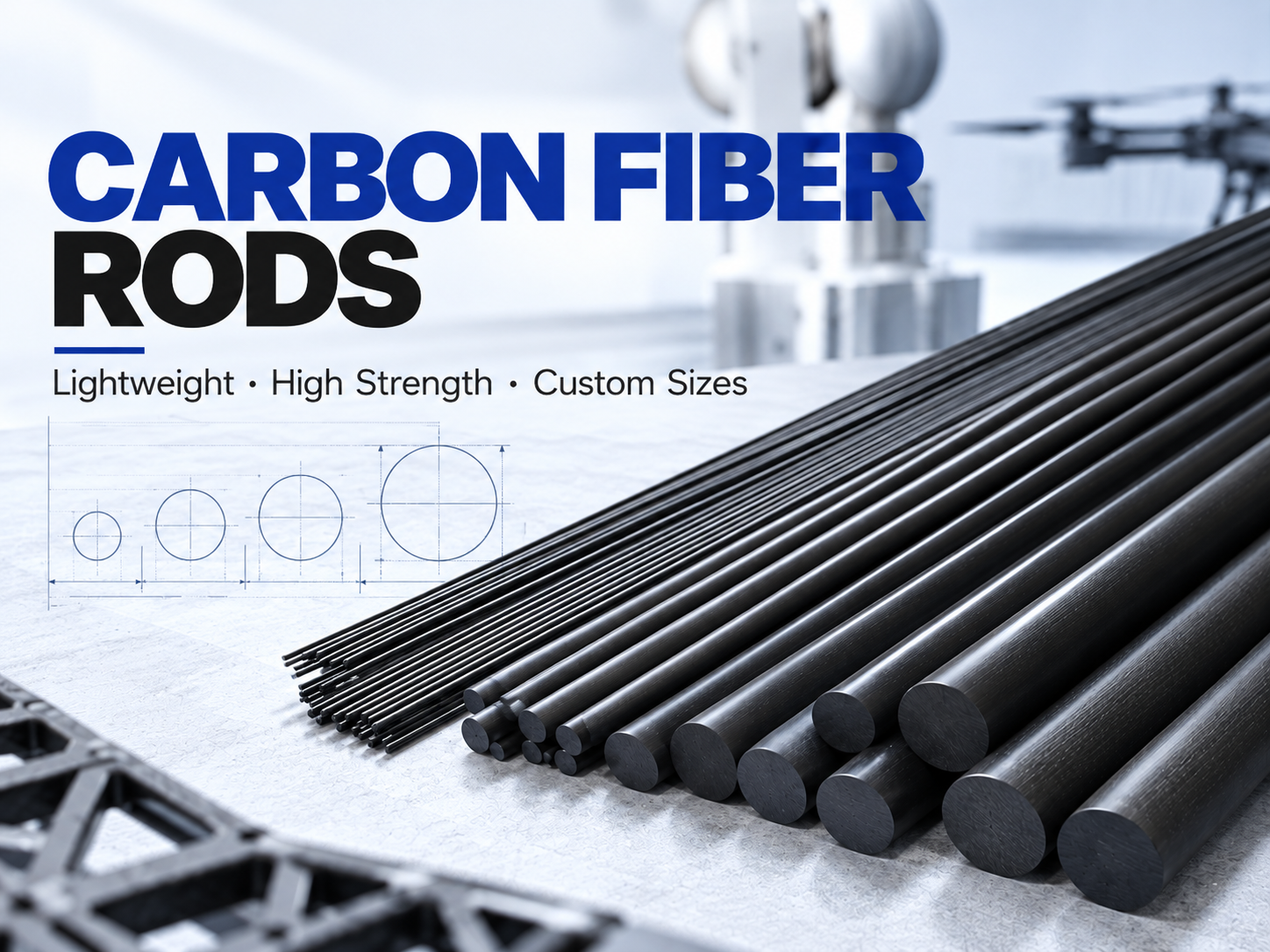
Pultruded carbon fiber rods are commonly used for straight, constant-section parts where low weight and high stiffness along the rod length are required.
Here is what we recommend confirming before requesting a quote.
1. Start With How the Rod Will Be Used
Tell the manufacturer what the rod actually needs to do.
Typical loads include tension, compression, bending and repeated movement. Clamps, holes and other connection points may also introduce local loads.
Pultruded carbon fiber rods normally contain a high proportion of continuous fibers running along the profile. Their strongest properties are therefore usually in the primary fiber direction.
If the design includes significant transverse loading, drilling or concentrated clamping, those areas should be reviewed separately.
Buyer Tip
A drawing and application description are often more useful than diameter alone.
2. Confirm the Critical Dimensions
For most custom carbon fiber rod projects, confirm:
- Diameter
- Finished length
- Diameter tolerance
- Straightness requirement, if critical
- Cut condition
- Secondary machining
Not every part needs the tightest possible tolerance.
A general structural component may accept a normal production tolerance, while a rod fitted into a sleeve or precision assembly may require tighter dimensional control.
If the rod must fit another component, send the mating dimensions or assembly drawing. This helps the manufacturer evaluate the tolerance that is actually required.
3. Know What Pultrusion Can Do
Pultrusion is a continuous process widely used for carbon fiber rods and other constant-section composite profiles.
Continuous carbon fibers are combined with resin and pulled through a forming and curing die. The finished profile leaves the process with essentially the same cross-section along its length.
This makes pultrusion suitable for repeat production of straight rods.
Pultrusion is intended for constant or near-constant cross-sections.
If the component requires a taper, changing diameter or complex molded geometry, another composite manufacturing process may be more suitable.
4. Review Machining and Connections Before Production
Carbon fiber rods can be cut, drilled, slotted and machined, but these operations should be considered as part of the final design.
Drilling cuts through continuous reinforcement. Clamping can create local pressure. Poorly positioned features may weaken an otherwise well-designed rod.
Depending on the assembly, the design may use bonding, sleeves, inserts or machined end features.
There is no single connection method that is best for every project.
If machining or assembly features are required, include them in the drawing before sampling rather than adding them after the rod has already been produced.
5. Check the Working Environment
The environment can influence both material selection and connection design.
- Continuous operating temperature
- Short-term peak temperature
- Outdoor or UV exposure
- Chemical exposure
- Moisture
- Contact with metal parts
Carbon fiber is electrically conductive.
When CFRP is in direct electrical contact with metals such as aluminum and an electrolyte such as moisture is present, galvanic corrosion of the metal can become a design concern.
Electrical isolation or other protective measures may therefore need to be considered.
If electrical insulation itself is a requirement, a fiberglass rod is normally a more appropriate material to evaluate first.
How Should a Buyer Check Carbon Fiber Rod Quality?
Appearance alone is not enough. For most incoming inspections, check the following points:
Diameter and Length
Compare them with the confirmed drawing or specification.
Straightness
If straightness affects assembly or movement, define the requirement before production.
Surface Condition
Look for visible cracks, exposed fibers or abnormal surface defects.
Machined Features
Check hole position, slot dimensions, cut length and other processed areas against the drawing.
Batch Consistency
For repeat orders, consistency between batches is usually more important than how one sample looks.
If mechanical performance is critical, agree on the test method and acceptance criteria before mass production.
Where Are Pultruded Carbon Fiber Rods Used?
Typical applications include:
- Robotics and automation
- UAV and lightweight structures
- Lightweight linkages
- Precision supports
- Sporting equipment
- Custom industrial components
These are application examples rather than guarantees of suitability.
The final selection still depends on load, dimensions, connections and operating conditions.
What Should You Send for a Carbon Fiber Rod Quote?
For a faster and more accurate quotation, provide:
- Diameter
- Finished length
- Quantity
- Tolerance
- Straightness requirement, if critical
- Machining requirements
- Working environment
- Intended application
- Drawing or sample
At Meibang, we check existing tooling and manufacturing feasibility against the required specification before sampling or batch production.
If the rod is part of a larger assembly, sending the assembly drawing at the beginning usually helps avoid unnecessary changes later.
FAQ
What is a pultruded carbon fiber rod?
A pultruded carbon fiber rod is a continuous composite profile made primarily from continuous carbon fiber reinforcement and resin, with a constant or near-constant cross-section along its length.
Can carbon fiber rods be drilled or machined?
Yes. Cutting, drilling, slotting and other machining operations are possible, but machining interrupts the reinforcement and must be considered together with the final load and assembly design.
Is carbon fiber rod better than fiberglass rod?
Not in every application. Carbon fiber is commonly selected when low weight and high stiffness are priorities. Fiberglass is often considered when electrical insulation or lower material cost is more important.
What information is needed for a custom carbon fiber rod quote?
Diameter, length, quantity, tolerance, machining requirements, application and a drawing or sample are the most useful starting information.
Navigation
Send Us A Message
Get in touch with us
Phone