

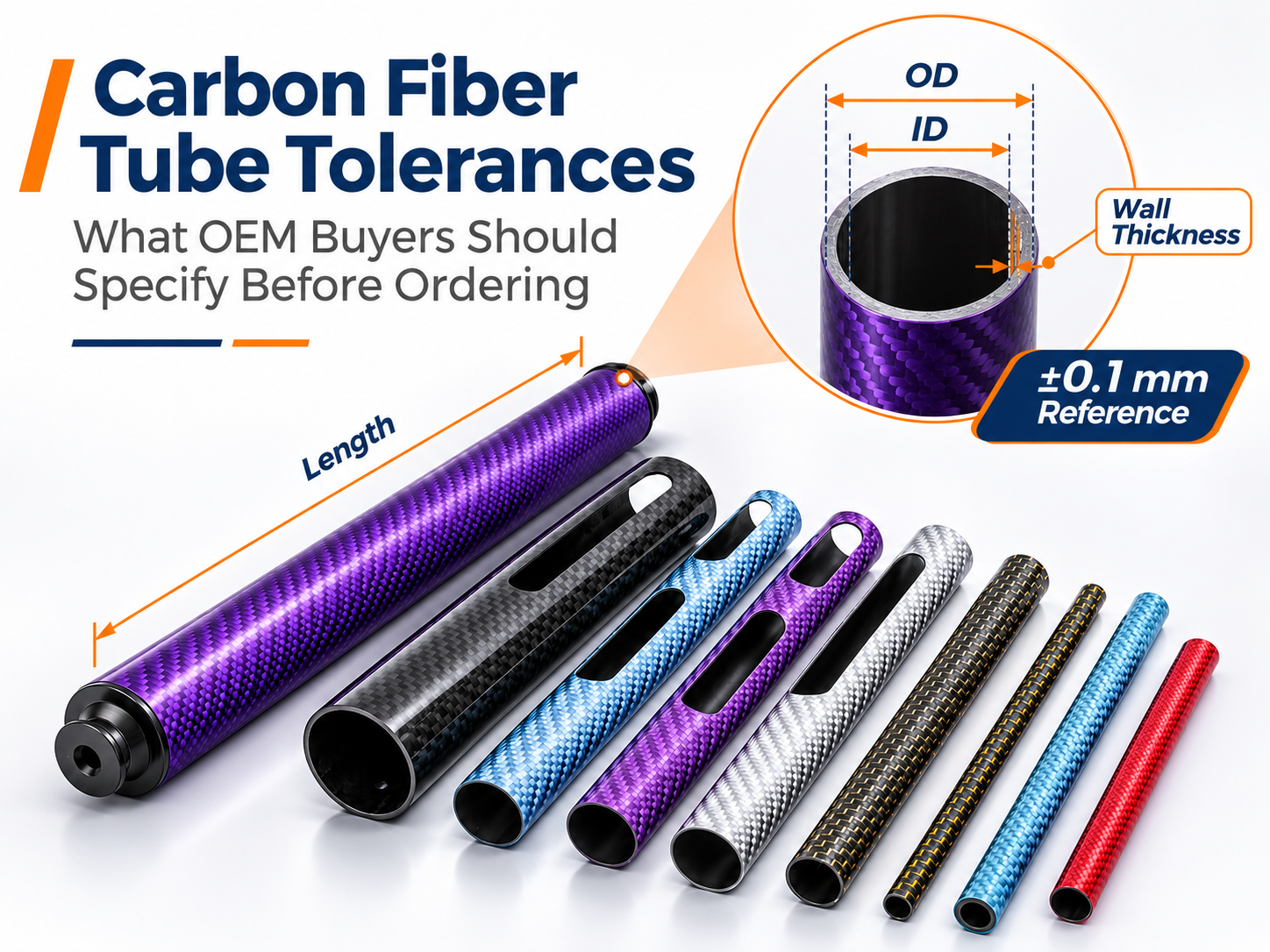
Carbon Fiber Tube Tolerances: What OEM Buyers Should Specify Before Ordering
Carbon fiber tube tolerance is not one fixed number.
OD, ID, length, straightness and machined features may require different levels of control. The achievable tolerance also depends on tube size, manufacturing process, tooling and finishing.
For many Meibang carbon fiber tube projects, ±0.1 mm can be used as a general reference for standard tube dimensions. Critical or tighter tolerances need to be reviewed against the actual part and feature.
For OEM buyers, the key is simple:
Control the dimensions that affect fit, alignment and performance.
1. Which Dimensions Matter Most?
A custom carbon fiber tube drawing usually includes:
Not every dimension needs the same tolerance.
If the tube fits into an external clamp, OD may be critical. If an insert fits inside the tube, ID may matter more.
The drawing should focus on the dimensions that affect the final assembly rather than applying the tightest tolerance everywhere.
2. OD, ID and Wall Thickness Are Related
For a nominally round and concentric tube:
Nominal Wall Thickness = (OD − ID) / 2
This is a design relationship, not a guarantee that the actual wall thickness is identical at every point around the tube.
Composite tube dimensions can be influenced by layup, consolidation, tooling and process variation.
If OD controls the assembly fit while ID only needs clearance, there may be no reason to apply the same tight tolerance to both.
Tolerance should follow function.
3. Manufacturing Process Affects Tolerance
Different manufacturing processes have different dimensional characteristics.
Roll-Wrapped Tubes
Roll-wrapped tubes are built around a mandrel. The mandrel strongly influences the internal geometry, while OD is also affected by layup thickness, consolidation, curing and surface finishing.
Pultruded Tubes
Pultrusion produces continuous constant-section profiles through a forming and curing die. It is suitable for repeat production, but actual tolerance still depends on profile size, tooling, reinforcement and process control.
Filament-Wound Tubes
Filament winding places reinforcement around a mandrel at controlled angles. Dimensions depend on the winding construction, tooling, curing and subsequent finishing.
The process name alone does not define the final tolerance. The actual drawing still needs to be reviewed.
4. Tube Dimensions and CNC Features Are Different
The tube itself has an as-produced dimensional capability.
Secondary machining creates another group of controlled features, such as:
- Finished cut length
- Drilled holes
- Hole position
- Slots
- Milled openings
- Chamfers
These features can be specified and inspected separately from the general tube dimensions.
CNC machining, however, should not be treated as a way to correct every OD or ID.
Machining the CFRP tube body can remove or interrupt reinforcement. Structural OD, ID or surface machining therefore needs to be evaluated before production.
5. Do Not Over-Tolerance the Drawing
A tighter tolerance is not always better.
Unnecessary tight tolerances can increase:
- Inspection requirements
- Secondary processing
- Rejection or rework risk
- Production cost
For example, if ±0.1 mm is already sufficient for the required fit, specifying ±0.02 mm without a functional reason may increase cost without improving the finished assembly.
Critical Dimensions
These directly affect fit, alignment or performance, such as clamp OD, insert ID, hole position, slot width or finished length.
Non-Critical Dimensions
These can remain within the normal capability of the selected manufacturing process.
The goal is not to make every tolerance as tight as possible. The goal is to control the dimensions that matter.
6. What Should Be Shown on the Drawing?
For a custom carbon fiber tube, provide:
- OD
- ID or wall thickness
- Finished length
- Critical tolerances
- Straightness requirement, if needed
- Hole diameter and position
- Slot dimensions and position
- Machining requirements
- Mating-part dimensions, if available
If a hole or slot is positioned from a specific reference, show that reference clearly on the drawing.
If straightness is critical, define how it will be measured and over what length.
For clamps, inserts or sleeves, providing the mating dimensions helps the manufacturer evaluate the actual fit instead of reviewing the tube alone.
7. What Should a Buyer Check Before Approving the Sample?
Inspection should follow the approved drawing.
OD and ID
Measure at agreed locations using the agreed inspection method.
Finished Length
Check against the drawing.
Straightness
Use an agreed method if straightness is critical.
Hole and Slot Position
Check from the specified reference or datum.
Assembly Fit
When possible, test the tube with the actual clamp, sleeve, insert or mating component.
For an OEM order, terms such as “high precision” or “tight tolerance” are not enough.
The drawing should define what actually needs to be controlled. For repeat orders, the same critical dimensions should remain controlled during batch production.
Meibang Carbon Fiber Tube Capability
Dongguan Meibang Fiberglass Products Co., Ltd. manufactures custom carbon fiber tubes for OEM and industrial applications.
- Roll Wrapping
- Pultrusion
- Filament Winding
- OD up to 200 mm
- Length up to 3.5 m
- Custom wall thickness
- T300 / T700 / T800 carbon fiber options
- Plain, twill and UD reinforcement options
- Matte, glossy and custom finishes
- Cutting, drilling, slotting, milling and chamfering
For many standard carbon fiber tube projects, ±0.1 mm can be used as a general dimensional reference, not a universal tolerance guarantee for every dimension or machined feature.
Tighter requirements need to be reviewed according to tube size, manufacturing process, tooling and secondary machining.
What Should You Send for a Custom Carbon Fiber Tube Quote?
For a more accurate feasibility review and quotation, provide:
- OD
- ID or wall thickness
- Finished length
- Quantity
- Required tolerance
- Straightness requirement, if critical
- Machining details
- Mating-part dimensions
- Intended application
- 2D drawing or 3D model
If you are not sure which tolerance is necessary, mark the dimensions that directly affect assembly or performance first. The remaining dimensions can then be reviewed according to the manufacturing process.
FAQ
What is a typical carbon fiber tube tolerance?
There is no single tolerance for every carbon fiber tube. Tube size, manufacturing process, tooling, finishing and the dimension being controlled all affect the achievable result. At Meibang, ±0.1 mm can be used as a general reference for many standard tube dimensions.
Can carbon fiber tubes be CNC machined to tighter tolerances?
Certain secondary features, such as cut length, holes and slots, can be controlled separately through machining. Structural OD, ID or surface machining needs to be evaluated before production because machining can remove or interrupt reinforcement.
Which is more important, OD or ID tolerance?
It depends on the assembly. OD may control an external clamp or sleeve fit, while ID may be more important for an insert or internal mating component.
Should OD, ID and wall thickness all have tight tolerances?
Not necessarily. They are geometrically related, and actual wall distribution also depends on the manufacturing process. Tight control should be applied where there is a functional requirement.
What should be included on an RFQ drawing?
Include OD, ID or wall thickness, length, critical tolerances, machining features, straightness requirements where necessary and mating-part information when assembly fit is important.
Need a Custom Carbon Fiber Tube With Controlled Tolerances?
Send us your drawing, critical dimensions and mating-part information.
Meibang can review the manufacturing process, tooling and secondary machining requirements before sampling.
WhatsApp / Phone: +86 18320223161
Factory: Qingxi Town, Dongguan, Guangdong, China
Navigation
Send Us A Message
Get in touch with us
Phone