
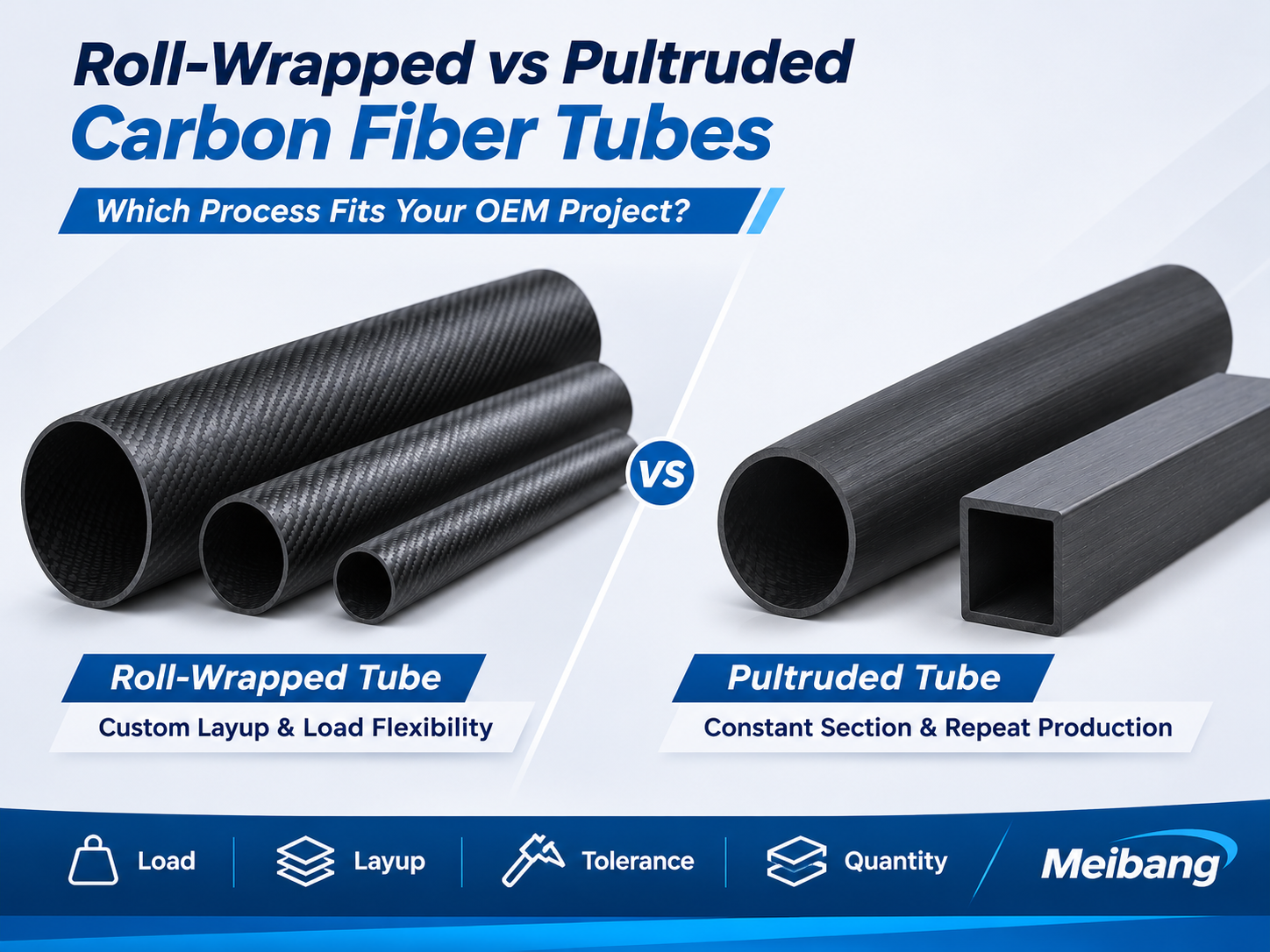
Roll-Wrapped vs Pultruded Carbon Fiber Tubes: Which Process Fits Your OEM Project?
Roll-wrapped and pultruded carbon fiber tubes may look similar, but they suit different OEM requirements.
The choice should not start with the visible carbon weave. It should start with the part:
- How is the tube loaded?
- Does the layup need to be customized?
- Which dimensions affect assembly?
- Is secondary machining required?
- What is the expected quantity?
As a practical starting point:
Pultrusion is often suitable for constant-section parts where longitudinal performance, repeat production and production efficiency matter.
Roll wrapping is often more suitable when the tube needs customized fiber orientation, combined bending and torsion, local reinforcement or more flexible wall construction.
At Meibang, both processes are available, so the manufacturing route can be reviewed around the actual part rather than forcing the project into one process.
1. Quick Comparison for OEM Buyers
Neither process is automatically stronger.
Final performance still depends on fiber orientation, wall thickness, resin system, fiber content, tube geometry and manufacturing control.
2. When Does Pultrusion Make Sense?
Pultrusion is a continuous process used to produce constant-section composite profiles.
It is commonly considered for projects with:
- Straight, constant-section geometry
- Mainly longitudinal loading
- Stable specifications
- Repeat production
- Relatively long profiles
Pultruded carbon fiber products often use a high proportion of longitudinal reinforcement, making them useful for loads carried mainly along the profile length.
Pultrusion should not be treated as a “0° fiber only” process. Depending on the profile and process design, additional reinforcement forms may be incorporated.
For stable sections and repeat quantities, continuous production can provide good manufacturing efficiency.
If the part has significant torsion, clamp loads, off-axis loading or demanding machining features, the reinforcement structure and final assembly should still be reviewed before the process is selected.
3. When Does Roll Wrapping Make Sense?
Roll-wrapped tubes are typically formed by applying carbon-fiber prepreg or resin-impregnated carbon-fabric layers around a mandrel and curing the specified laminate.
The exact material system depends on the project requirements.
The construction can be adjusted through:
- Fiber orientation
- Number of plies
- Wall structure
- Local reinforcement
- Outer surface layer
This makes roll wrapping useful when the tube experiences more than one type of load.
Longitudinal reinforcement contributes to axial and bending performance.
±45° reinforcement can contribute to torsional and shear performance.
Hoop-oriented reinforcement can help with circumferential stability or local radial loads.
Typical applications include UAV arms, robotics, automation structures, sporting equipment and tubes with clamp or joint loads.
Roll wrapping provides greater layup flexibility for combined loads, but the process name alone does not guarantee torsional performance.
The visible 3K twill surface should not be confused with the full structural laminate. A woven outer layer may be mainly cosmetic while most of the load-carrying reinforcement is underneath.
4. How Does Quantity Affect the Choice?
Quantity matters, but it should not decide the process by itself.
The lowest tube-production cost is not always the lowest finished-part cost.
Tooling, material usage, machining, inspection, scrap risk and repeatability should be evaluated together.
5. Tolerance and Machining Need Separate Review
The process name does not define the final tolerance.
Dimensional capability also depends on tube size, wall structure, tooling, finishing, inspection method and secondary machining.
For suitable tube sizes and structures, ±0.1 mm can be used as a general dimensional reference at Meibang, subject to drawing and process review.
This is not a blanket tolerance for every OD, ID, length or machined feature.
External clamp → OD may be critical
Bonded insert → ID may be critical
Drilled assembly → hole position may matter
Long structure → straightness may need control
Hole position, slot size and assembly surfaces should be reviewed separately on the drawing.
For suitable projects, Meibang can also evaluate drawing-based secondary machining including:
- Cutting
- Drilling
- Chamfering
- Threading
- Turning
Machining can remove or interrupt reinforcement, and poor tooling or cutting parameters may cause edge damage or delamination. Machined features should therefore be reviewed together with the tube structure before sampling.
Related Guide
Carbon Fiber Tube Tolerances: What OEM Buyers Should Specify Before Ordering
6. How Meibang Reviews an OEM Project
When we receive a carbon fiber tube drawing, we do not choose the process from OD and length alone.
We review:
- Tube geometry
- Main load direction
- Critical dimensions
- Machining features
- Mating components
- Production quantity
- Surface requirements
For a constant-section part with mainly longitudinal loading and repeat volume, continuous pultrusion may be evaluated first.
If the part requires customized fiber orientation, combined loading, local reinforcement or more flexible wall construction, carbon-fabric winding may be a better starting point.
The process is then reviewed together with tooling, machining and inspection requirements before sampling.
Meibang Manufacturing Capability
Dongguan Meibang Fiberglass Products Co., Ltd. was established in 2015 in Qingxi, Dongguan, China.
Workshop: approximately 3,000 m²
Pultrusion lines: 9
Carbon-fabric winding machines: 3
Confirmed production routes include:
- Continuous Pultrusion
- Carbon-Fabric Winding / Roll Wrapping
- Compression Molding
For suitable standard pultruded profiles, production capacity can exceed 10,000 metres per day.
This figure applies to applicable standard pultruded profiles and should not be interpreted as the output of every roll-wrapped tube or custom component.
Carbon fiber options may include T300-, T700-, T800- and T1100-grade materials, depending on the project.
If a specific material manufacturer or exact fiber grade, such as a Toray material, is required, identify it on the RFQ so availability and cost can be confirmed before quotation.
Fiber grade alone does not determine final component performance. Layup, resin system, fiber content, geometry and manufacturing control also matter.
For simple projects using available tooling and material, standard samples can usually be prepared in about 2 days.
For urgent requirements, some existing-tool samples may be dispatched within approximately 12 hours when material, machining and production conditions allow.
Actual sample timing is confirmed after the drawing is reviewed.
What Should You Send for a Quote?
For a useful process review, provide:
- OD
- ID or wall thickness
- Finished length
- Quantity
- Application
- Main load direction
- Required tolerance
- Machining details
- Mating-part dimensions
- Surface finish
- 2D drawing or 3D model
If you have not decided the layup or manufacturing process, send the drawing and application first. We can review the manufacturing route around the actual part.
FAQ
Is a roll-wrapped carbon fiber tube stronger than a pultruded tube?
Not necessarily.
Performance depends on load direction, reinforcement architecture, wall structure, resin system, fiber content and tube geometry. Roll wrapping provides more flexibility in tailoring the laminate, while pultrusion is well suited to continuous constant-section production and structures where longitudinal properties are important.
Are pultruded carbon fiber tubes only made with 0° fibers?
No. Longitudinal reinforcement is common in carbon pultrusion, but additional reinforcement forms may be incorporated depending on the profile and process design.
Are roll-wrapped tubes better for torsional loads?
Roll wrapping provides greater freedom to include ±45° and other reinforcement directions. However, final torsional performance still depends on the actual layup, wall construction, geometry and test requirements.
Which process is cheaper?
There is no fixed answer.
Pultrusion can be efficient for stable, repeat constant-section production, while roll wrapping offers more flexibility for custom layups and smaller batches. Tooling, material, machining, inspection, finishing and production quantity should be compared as part of the complete component cost.
Not Sure Which Process Fits Your Carbon Fiber Tube?
Send us your drawing, application and expected quantity.
Meibang can review the load condition, tube geometry, tolerance, production quantity and machining requirements before recommending a manufacturing route.
Email: meibangfrp@163.com
Factory: Building A, Guanghui High-Tech Industrial Park, No. 18 Longjiang Road, Xiekeng, Qingxi Town, Dongguan, Guangdong, China
Navigation
Send Us A Message
Get in touch with us
Phone