
Carbon Fiber Tubes for Drones & UAVs: A Buyer’s Guide to Layup, CNC Machining and Supplier Selection
Carbon fiber tubes are widely used for drone arms and lightweight UAV structures, but OD and wall thickness alone are not enough to define the right tube.
Arm length, motor thrust, bending and torsional loads, joint design, hole positions and machining all affect the final specification. Two tubes with the same dimensions can perform differently because of their layup and manufacturing process.
For an OEM UAV project, start with the actual arm assembly rather than a catalog size.
1. Start With the UAV Arm
There is no fixed rule that a certain drone weight requires a 20 mm, 30 mm or 40 mm carbon fiber tube.
Useful project information includes:
- Arm length
- Maximum takeoff weight
- Maximum thrust per motor
- Bending and torsional loads
- Clamp or folding-joint design
- Hole and slot locations
- Allowable deflection, if critical
For an existing UAV, an assembly drawing is usually more useful than simply requesting “a carbon fiber tube for a 30 kg drone.”
When replacing an aluminum arm with CFRP, the original dimensions should also be reviewed rather than copied directly. Carbon fiber has directional properties, so tube geometry and layup need to be considered together.
2. Fiber Layup Matters
A 3K twill surface does not tell you how a UAV tube will perform.
For a roll-wrapped tube, different fiber directions contribute to different parts of the structural response.
0° Reinforcement
Contributes strongly to longitudinal stiffness and bending performance.
±45° Reinforcement
Helps carry torsional and shear loads.
90° or Hoop Reinforcement
Can improve circumferential stability and resistance to local radial loads.
Overall performance still depends on the full layup, fiber content, resin system and tube geometry.
This is why two tubes with the same OD and wall thickness may behave differently in the same UAV assembly.
3. Which Manufacturing Process Fits the Project?
Different tube processes suit different requirements.
Roll-wrapped tubes are often considered for UAV arms because fiber orientation can be adjusted according to the load requirements.
Pultrusion is efficient for constant-section profiles and is commonly used where repeatability and longitudinal properties are important. It should not automatically be described as a “0° fiber only” process, because the reinforcement system can include additional fiber forms.
Filament winding can also be evaluated when the tube design benefits from controlled winding angles.
The process should follow the part requirements.
4. Plan CNC Machining Before Sampling
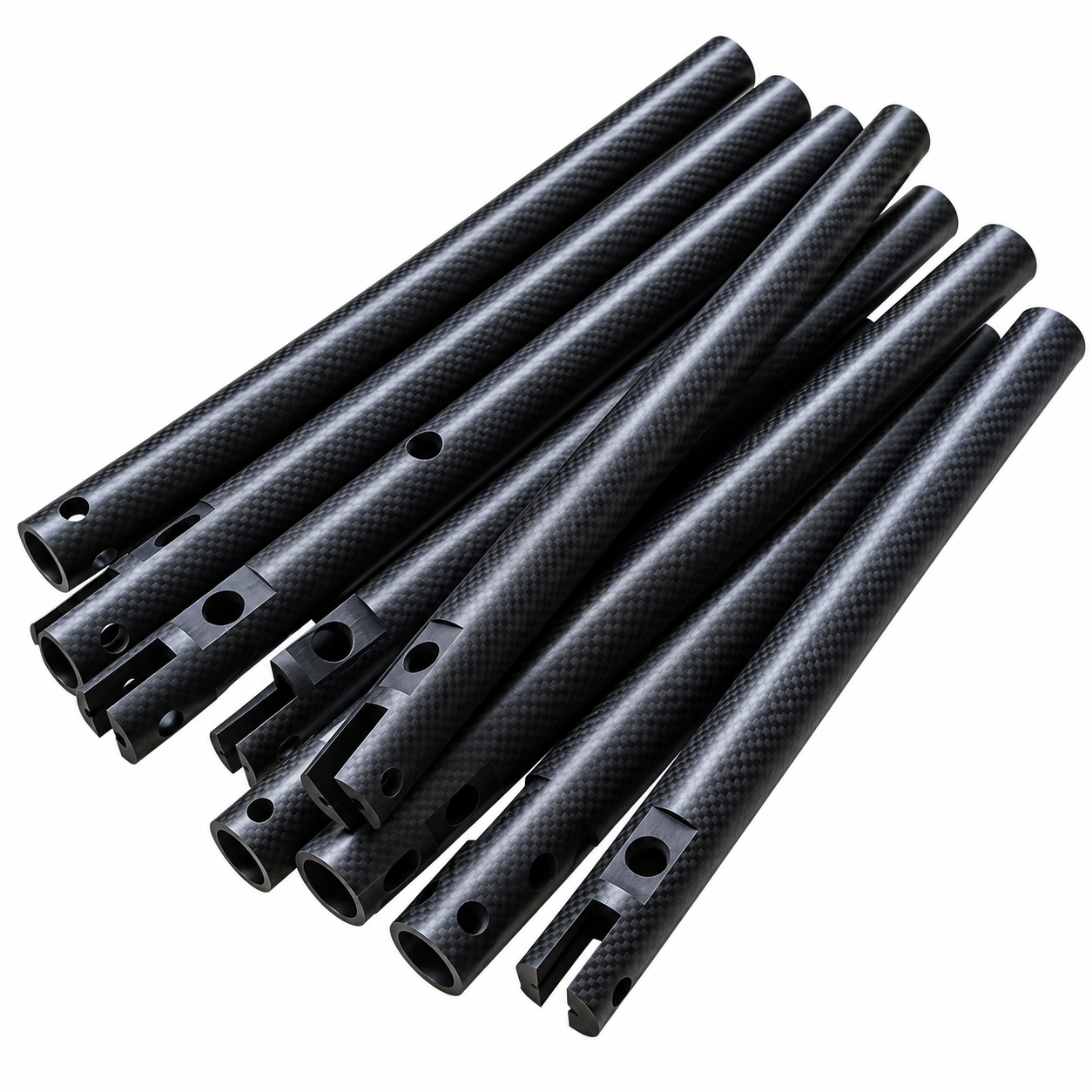
Drone arms often require secondary processing such as:
- Cut-to-length
- Drilling
- Cable-routing slots
- Milling
- Chamfering
- Clamp or hinge features
CFRP machining needs controlled tooling and process parameters. Drilling and milling remove or interrupt reinforcement, while poor machining can lead to delamination, fiber pull-out or damaged edges.
Hole position also matters, especially near clamps and other highly loaded areas. For UAV projects, machining details are best included in the drawing before sampling.
At Meibang, secondary processing can include cutting, drilling, slotting, milling and chamfering according to customer drawings.
For standard carbon fiber tube production, ±0.1 mm can be used as a general dimensional reference. Tighter local tolerances need to be reviewed according to tube size, manufacturing process and machined feature.
5. Check the Clamp and Joint Fit
For many UAV arms, the tube-to-joint interface deserves as much attention as the tube itself.
A clamp needs enough holding force without creating excessive local pressure. Folding mechanisms also require controlled fit and repeatable positioning.
Useful dimensions include:
- Tube OD and ID
- Clamp bore
- Insertion length
- Hole position
- Slot position
- Critical assembly tolerance
If the tube connects to an existing clamp or folding joint, provide the mating dimensions together with the tube drawing.
The finished tube must not only meet its own dimensions; it also needs to fit the final assembly correctly.
6. What Should You Check When Comparing Suppliers?
Price and one good-looking sample are not enough for an OEM program.
A carbon fiber tube supplier should be able to review the drawing, confirm the material and manufacturing process, identify critical dimensions and understand which features need inspection.
The approved sample should also represent the intended production process as closely as possible.
For critical items such as OD, hole position, slot size or assembly fit, put the requirement on the drawing instead of relying only on email communication.
For repeat orders, consistency matters more than one perfect prototype.
7. What Should Be Checked Before Mass Production?
For UAV tubes, appearance is only one part of inspection.
Dimensions
Check OD, ID or wall thickness, finished length and critical tolerances.
Straightness
Define a requirement if it affects clamps, folding joints or final alignment.
Layup and Process
Production parts should follow the approved construction and process.
Machining
Hole positions, slots and finished edges should match the drawing.
Assembly Fit
Whenever possible, test the sample with the actual clamp, motor mount or folding mechanism.
If the project has defined mechanical requirements, the test method and acceptance criteria should be agreed before production.
Meibang Carbon Fiber Tube Manufacturing Capabilities
Dongguan Meibang Fiberglass Products Co., Ltd. has manufactured carbon fiber and fiberglass composite products since 2015.
Our composite manufacturing capabilities include Roll Wrapping, Pultrusion, Filament Winding, Braiding, Compression Molding and CNC secondary machining.
For custom carbon fiber tubes, available options include:
- OD up to 200 mm
- Length up to 3.5 m
- Custom wall thickness
- T300 / T700 / T800 carbon fiber options
- Plain or twill woven fabric and UD reinforcement depending on the required layup
- Matte, glossy and custom surface finishes
- Cutting, drilling, slotting, milling and chamfering
Our factory in Dongguan covers more than 3,500 m² and supports OEM/ODM projects based on drawings, samples and application requirements.
What Should You Send for a UAV Carbon Fiber Tube RFQ?
For an accurate quotation, provide as much of the following information as possible:
- OD
- ID or wall thickness
- Finished length
- Quantity
- Required tolerance
- Carbon fiber grade, if specified
- Surface finish
- Hole and slot dimensions
- Clamp or joint dimensions
- Motor or load information
- 2D drawing or 3D model
If the tube is part of an existing UAV assembly, include the assembly drawing.
This allows the tube, machining and connection details to be reviewed together before sampling.
FAQ
Are roll-wrapped carbon fiber tubes suitable for drone arms?
Often, yes. Roll wrapping allows different fiber orientations to be combined for bending, torsional and local load requirements. The final layup still depends on the actual UAV structure.
What wall thickness should a UAV carbon fiber tube use?
There is no universal wall thickness. Tube diameter, arm length, motor thrust, required stiffness, layup and joint design all affect the specification.
Can carbon fiber UAV arms be CNC machined?
Yes. Carbon fiber tubes can be cut, drilled, slotted and milled. Feature location and machining method need to be considered because these operations remove or interrupt part of the reinforcement.
What tolerance can Meibang provide?
±0.1 mm is a general dimensional reference for standard carbon fiber tube production. Tighter requirements should be evaluated according to tube dimensions, manufacturing process and machining requirements.
What should I send before requesting a sample?
A drawing is the best starting point. If no drawing is available, provide the OD, ID or wall thickness, length, quantity, intended application and critical assembly requirements.
Need a Custom Carbon Fiber Tube for Your UAV Project?
Send us your UAV arm drawing, tube dimensions and machining requirements.
Meibang can review the manufacturing process, tube construction and secondary machining requirements before sampling.
Email: chaomeicrp@163.com
WhatsApp / Phone: +86 18320223161
Factory: Qingxi Town, Dongguan, Guangdong, China
Navigation
Send Us A Message
Get in touch with us
Phone