

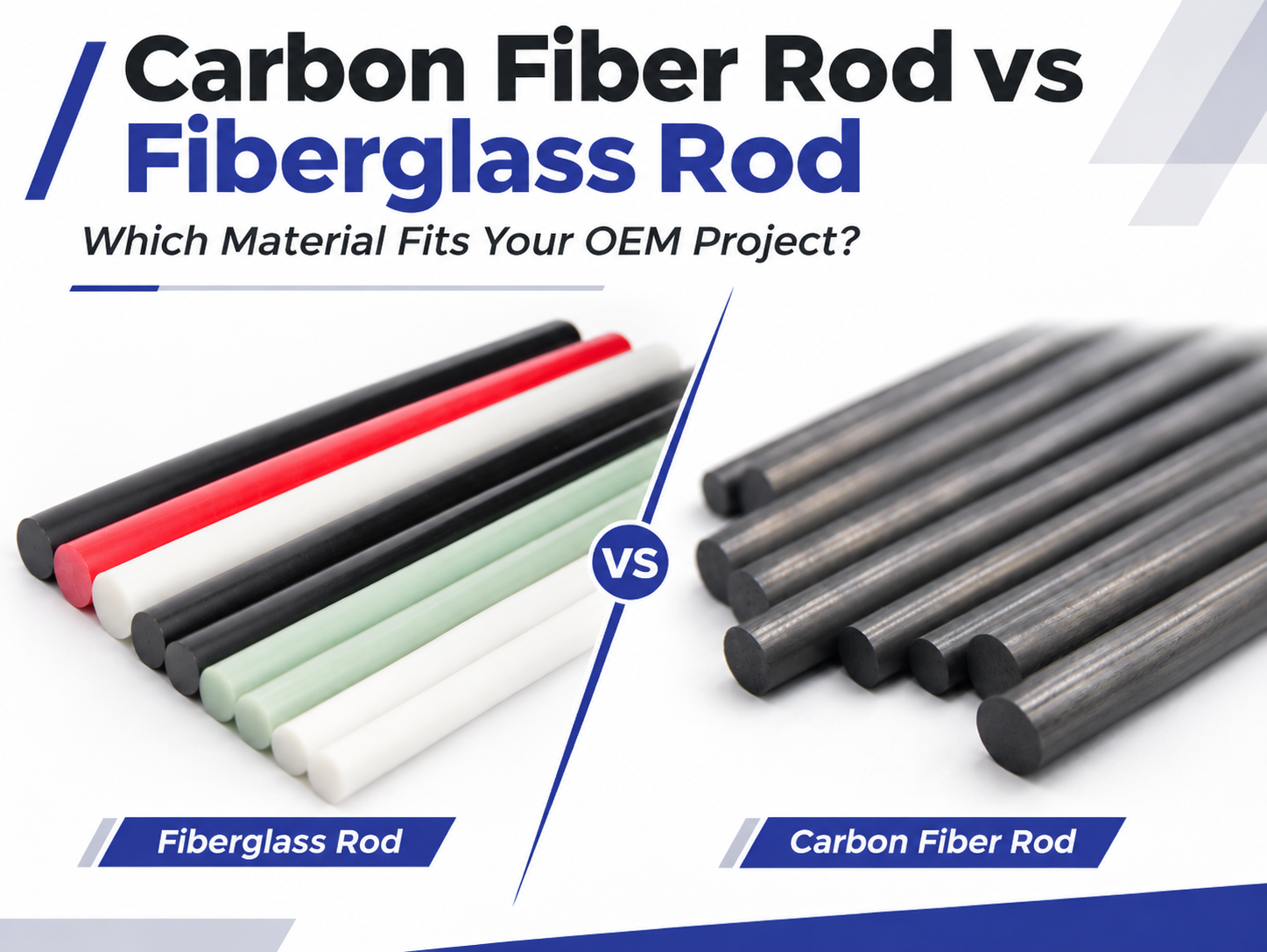
Fiberglass Rod vs Carbon Fiber Rod: Which Material Fits Your OEM Project?
Fiberglass rods and carbon fiber rods are both widely used in OEM products, but they solve different engineering problems.
For most buyers, the useful question is not:
"Which material is stronger?"
A better question is:
"Which material gives the part the stiffness, weight, electrical behavior and cost that the application actually needs?"
As a practical starting point:
Carbon Fiber: Evaluate carbon fiber when low mass and high stiffness are major priorities.
Fiberglass: Evaluate fiberglass when electrical insulation, more allowable bending or lower material cost matters more.
The final choice should still be based on the finished part, not the material name alone.
1. Quick Comparison for Buyers
This table is only a starting point.
Rod diameter, length, fiber direction, resin system, fiber content and connection design can all change how the finished component behaves.
2. When Carbon Fiber Rod Makes More Sense
Carbon fiber rod is often selected when a component needs to remain stiff without adding unnecessary mass.
Typical applications include:
- Robotics
- Automation equipment
- UAV structures
- Lightweight linkages
- Positioning components
- Lightweight structural supports
Many pultruded carbon fiber rods use predominantly continuous fibers running along the length of the profile.
This makes them particularly useful where longitudinal stiffness is important.
But carbon fiber is not equally strong or stiff in every direction.
Side loading, drilled holes, clamps and other local features introduce loads that may not follow the main fiber direction.
For an OEM project, information about the application and connection method is therefore more useful than simply asking for a "10 mm carbon fiber rod."
3. When Fiberglass Rod Makes More Sense
Fiberglass is often a practical option when the product does not require maximum stiffness-to-weight performance.
Common applications include:
- Sports and training equipment
- Electrical components
- Outdoor support rods
- Markers
- Tent and portable structures
- General industrial parts
Fiberglass may also be more attractive when material cost is an important part of the project.
However, it should not simply be described as "more flexible."
A long, small-diameter fiberglass rod can deflect easily. A larger fiberglass profile can be relatively stiff.
If bending behavior matters, it is better to specify the expected load and acceptable deflection.
4. Strength and Stiffness Are Not the Same Thing
This is one of the most common sources of confusion when comparing composite rods.
Strength: Describes how much load or stress a material can withstand before a defined failure occurs.
Stiffness: Describes how much it resists elastic deformation under load.
A rod can be strong enough not to fail but still be too flexible for the assembly.
For comparable composite constructions, carbon-fiber-reinforced materials generally offer higher stiffness than standard glass-fiber-reinforced materials.
That is why carbon fiber is widely used in lightweight structures where deflection must be limited.
Fiberglass generally offers lower stiffness in a similar geometry, which can be useful when some bending is acceptable or required.
For example, an automation positioning member may need low deflection.
A golf training rod or volleyball antenna may need controlled flexibility instead.
The application determines which behavior is useful.
5. Electrical Requirements Can Change the Material Choice Quickly
Carbon fiber reinforcement is electrically conductive.
As a result, a conventional carbon-fiber-reinforced rod is normally not the first material to evaluate when electrical insulation is a functional requirement.
Glass-fiber-reinforced polymers are commonly used for low-conductivity and insulating applications.
But the word "fiberglass" by itself does not guarantee a specific electrical rating.
Actual electrical performance can also depend on:
- Resin system
- Fillers and additives
- Moisture
- Surface condition
- Metal fittings
- The complete assembly
If the project requires a defined dielectric strength, insulation voltage or resistivity, include that requirement in the specification.
The finished composite should then be evaluated using the appropriate test method.
6. Compare the Finished Part, Not Just the Material Price
Fiberglass is often the lower-cost material option for standard industrial rod applications.
Carbon fiber usually carries a higher material cost.
That does not mean fiberglass always produces the cheaper finished component.
An OEM part may include:
Material + Tooling + Forming + Machining + Inspection + Assembly + Packaging
A lower-cost rod that requires additional machining or creates assembly problems may not provide the lowest total cost.
Likewise, carbon fiber may justify its higher material cost if reducing mass or deflection creates real value in the finished equipment.
The better comparison is:
Carbon fiber solution vs fiberglass solution for the same functional requirement.
7. Do Not Ignore the Working Environment
The reinforcement fiber is only one part of the composite.
Buyers should also consider:
- Service temperature
- UV exposure
- Moisture
- Chemical exposure
- Indoor or outdoor use
- Contact with metal parts
For outdoor applications, resin selection and surface protection can be important.
UV durability, for example, should not be judged from "carbon fiber" or "fiberglass" alone.
The matrix resin and surface system also influence long-term exposure performance.
Carbon fiber composites require another consideration when they are installed against metals.
If a conductive carbon composite is in electrical contact with a metal such as aluminum and moisture or another electrolyte is present, galvanic corrosion of the metal can become a concern.
Depending on the assembly, this may require an isolation layer, coating, sleeve or another connection strategy.
8. Machining and Connection Design Should Be Reviewed Early
Both carbon fiber and fiberglass rods can be cut and, for suitable designs, drilled or otherwise machined.
But composite machining changes the local reinforcement.
A drilled hole cuts fibers.
A clamp creates concentrated local pressure.
An insert changes how load enters the rod.
For this reason, the connection should be reviewed together with the rod rather than added after the rod specification has already been fixed.
Depending on the application, connection methods may include:
- Bonded sleeves
- Inserts
- External clamps
- Bonded end fittings
- Drawing-based machined features
There is no single best connection method for every composite rod.
The correct solution depends on the load, rod geometry and final assembly.
9. What Does This Look Like in Real Products?
Golf Alignment Sticks
Fiberglass is a practical material for golf alignment sticks.
These products normally need sufficient straightness, portability and controlled flexibility rather than maximum structural stiffness.
For a buyer, folding structure, color, packaging and cost may matter more than achieving the highest possible stiffness-to-weight ratio.
Volleyball Antennae
Fiberglass is also commonly used for volleyball antennae.
The rod needs to be flexible and clearly visible beside the net.
For detachable versions, the rod also has to work with the connecting sleeve, internal cord and final net system.
Robotics and Lightweight Supports
Carbon fiber becomes more attractive when low mass and low deflection directly affect equipment performance.
For these projects, straightness, machining, fitting dimensions and connection design can be just as important as the material itself.
These examples are not fixed rules.
They show why the application should come before the material choice.
10. What Should Be Confirmed Before Ordering?
Before selecting carbon fiber or fiberglass, it helps to answer a few practical questions.
What load does the rod carry?
Is it mainly in tension, compression or bending?
How much deflection is acceptable?
For many projects, this is more useful than asking for a "strong rod."
How does it connect to the assembly?
Bonding, clamps, sleeves, inserts and drilled holes create different local requirements.
Where will it be used?
Temperature, UV, moisture and chemicals may affect the resin and surface system.
Does it need electrical insulation?
If yes, this should be stated before material selection.
What quantity is required?
Prototype quantities and repeat production may lead to different tooling and manufacturing decisions.
11. How Meibang Reviews Carbon Fiber and Fiberglass Rod Projects
Meibang manufactures both carbon fiber and fiberglass composite products.
For a new OEM rod project, we normally review the application before confirming the material and production route.
Useful information includes:
- Rod diameter
- Finished length
- Quantity
- Tolerance
- Straightness requirement, if critical
- Load or allowable deflection
- Electrical requirement, if applicable
- Machining requirements
- Connection method
- Operating environment
- Drawing or reference sample
If carbon fiber better fits the stiffness and weight target, the carbon rod structure can be evaluated.
If fiberglass better fits the electrical, bending or cost requirement, the fiberglass option can be reviewed instead.
The objective is not to choose carbon fiber or fiberglass first.
It is to choose a rod that works in the finished product.
FAQ
Is carbon fiber rod stronger than fiberglass rod?
There is no useful universal answer.
Strength and stiffness are different properties, and composite performance also depends on fiber direction, fiber content, resin system, processing and rod geometry.
For many OEM projects, required stiffness and allowable deflection are more useful design inputs than a general "stronger" comparison.
Is fiberglass rod more flexible than carbon fiber rod?
For similar geometry and comparable composite construction, fiberglass-reinforced materials generally have lower stiffness and may deflect more under the same load.
However, rod diameter, length and construction can change the result substantially.
If flexibility matters, specify a load and deflection requirement.
Which material should I consider for electrical insulation?
Fiberglass-reinforced polymer is normally the better starting point when electrical insulation is required.
Carbon-fiber reinforcement is conductive.
For projects with defined electrical requirements, the complete material system and finished part should still be verified.
Can carbon fiber and fiberglass rods be machined?
Yes, for suitable designs.
Cutting, drilling and other secondary machining can be evaluated, but these operations remove or interrupt reinforcement.
Machined features should therefore be reviewed together with the load and connection design.
Which material is cheaper?
Fiberglass is often the more economical material for standard industrial applications.
The final part cost still depends on dimensions, resin system, tooling, quantity, machining and inspection requirements.
Not Sure Which Rod Material Fits Your Project?
You do not need to choose the material before contacting us.
Send:
Application + Diameter + Length + Quantity + Load or Deflection Requirement + Connection Method
If a drawing or existing sample is available, send that as well.
Meibang can review whether carbon fiber or fiberglass is the better starting point before sample production.
Email: meibangfrp@163.com
Factory: Building A, Guanghui High-Tech Industrial Park, No. 18 Longjiang Road, Xiekeng, Qingxi Town, Dongguan, Guangdong, China
Navigation
Send Us A Message
Get in touch with us
Phone